Welcome to CIMSpy – A CIM-based Model Exploratory Tool

CIMSpy (the Tool) is a standard-based model exploratory tool designed to address the emerging model exchange and information integration requirements in the power industry. Built upon Common Information Model (CIM) and its related IEC standards, the Tool provides a suite of comprehensive data engineering functions and rich user experience to help you understand and analyze your CIM-based power system models.
More specifically, the Tool is designed to provide an integrated data engineering environment in support of CIM-based model exchange, application integration, and information sharing. Users can load reality-based CIM/XML files into the tool and perform a variety of data engineering functionalities, including model browsing, visualization, validation, editing, comparison, conversion merging/partitioning, and incremental update. The engineered models can be further exported into various formats such as XML, CSV, and custom tabular, ready to be consumed by other CIM-compliant information infrastructures
Built as a distributed Web-based application, the Tool provides a set of infrastructure and application modules that can be assembled or configured to meet various project needs, ranging from standard-based model exchange to visualization of power system model and operating conditions, etc. Because the Tool is a CIM-based model-driven application, it can be seamlessly integrated with other foreign applications in an Enterprise Application Integration (EAI) framework or a Service-Oriented Architecture (SOA).
Background
CIMSpy started as an open-source project in 2005. The early version, i.e. CIMSpy Standard Edition (CIMSpy SE), was originally designed to support EPRI's CIM InterOP (IOP) tests. Since the introduction, it has been widely used in the CIM communities, including the past EPRI IOPs. However when using the tool to browse and validate the reality-based CIM models, users identified many limitations and restrictions in performance, scalability, and extensibility, etc.
Driven by the key requirements of some CIM-related projects in North America and Europe, CIMSpy was rebuilt to overcome the identified limitations in 2008. The enhanced version leverages the greatest and latest information technologies and delivers leading performance and comprehensive features addressing a variety of common requirements of CIM-related projects.
In 2011, 2012, and 2015, US Department of Energy (DOE) awarded Power Info LLC Small Business Innovation and Research (SBIR) grants in support of the continuous research on data-driven visualization of power grid, one of the key features of CIMSpy.
What's New?
Version 2.12.2 (May 2026)
Version 2.12.2 introduces preliminary support for SHACL validation, providing a standards-based mechanism for validating model content against defined data quality and conformance rules. It provides a flexible foundation for future expansion of SHACL-based model quality assurance and interoperability validation capabilities.
- Added preliminary support for SHACL validation, enabling users to validate loaded models against a configurable set of SHACL rules.
- Supports both profile-based validation, such as verifying compliance with CGMES 3.0 profiles, and business process-specific validation, such as Quality of CIM Data for Code Coordination (QoCDC) checks for System Operation and System Development processes.
- Validation results are integrated into the application, allowing users to identify and review model elements that violate defined SHACL constraints.
- Added configuration options that allow users to enable workarounds for known limitations or ambiguities in existing SHACL rule definitions.
Version 2.12 (March 2026)
Version 2.12 introduces preliminary support for the full set of Network Code Profiles (NCPs), along with major enhancements in scripting, automation, transformation, diagram, performance, and enterprise deployment support.
- Added preliminary support for the complete set of Network Code Profiles (NCPs). NCPs define additional datasets required to support power system operation in compliance with the EU Network Code requirements (https://www.entsoe.eu/data/cim/cim-for-grid-models-exchange/). The NCP framework consists of 17 profiles, including Contingency, Availability (Outage), Remedial Action, Object Registry, and others. A set of sample NCP models is also included in this release.
- Extended scripting and automation support to provide more user-friendly model modification and more powerful workflow automation capabilities.
- Introduced a CSV-based model scripting capability that allows users to modify loaded models quickly and conveniently without coding. The feature supports both instance-level updates and pattern-driven modifications, providing a simple yet powerful way to extend or patch models.
- Extended batch processing to provide a structured automation layer on top of internal services. With support for variables, conditional logic, script modularization, and robust logging, it enables users to create repeatable, scalable workflows for large-scale model management and transformation tasks.
- Enhanced diagram functionality, layout, and usability:
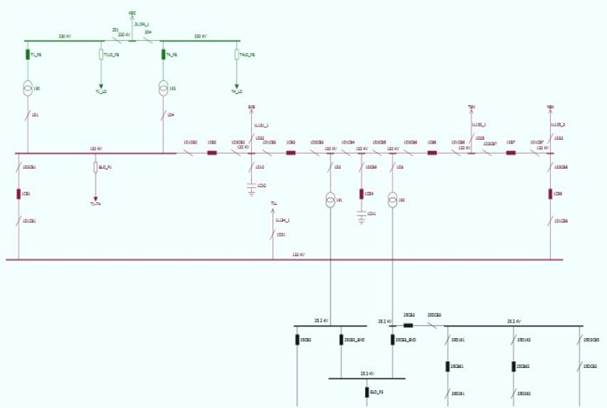
- Added Shortest Path functionality in both schematic and geographical diagrams, allowing users to trace connectivity between two selected substations.
- Improved substation diagram layout byrendering 3×2-winding transformersto visually resemble a 3-winding transformer.
- Improved multi-station diagram adjustment usability by adding support for flipping substations, removing substations, and resizing boundaries.
- Improved geographical diagram fault tolerance to handle missing or inconsistent data, including overlapping substations.
- Added the ability to extend substations in station and multi-station diagrams, improving layout flexibility and scalability.
- Enhanced Model Transformation Framework (MTF) to improve model transformation capability, transparency, and performance.
- Added support for contexts to conditionally enable transformation rules based on model conditions.
- Added alias support to define reusable intermediate values in transformation expressions.
- Added template support to enable reusable mapping patterns in model transformation.
- Added support for transformation validation with enhanced issue detection and reporting.
- Provided a mechanism to improve model transformation performance.
- Implemented comprehensive performance and scalability enhancements:
- Introduced property indexing to accelerate lookups and improve overall application performance when enabled. Property indexing is disabled by default and can be enabled for performance optimization.
- Significantly improved rendering performance for large geographical diagrams using multi-resolution and caching. With the enhanced technique, a 65,000-substation geographical diagram now renders in approximately 5 seconds (depending on hardware).
- Optimized database support to significantly improve model save and retrieval performance.
- Added support for lazy loading of “heavy” objects in large association trees within a Composite Form to improve UI responsiveness.
- Strengthened enterprise deployment support through improved data separation and per-user configuration storage.
- Implemented separation of application data from executable binaries to support safer deployments and better alignment with enterprise IT best practices. The installer provides an option to configure this separation during installation.
- Stored user profiles and bookmarks in the Windows Data Roaming profile directory to support shared installations while preserving per-user settings.
- Incorporated user feedback by implementing requested features and usability enhancements:
- Refactored Python support to enable importing external libraries under the new Python architecture.
- Added support for importing model files with non-ASCII file names.
- Added support for importing multiple files simultaneously via the file browser.
- Enhanced model loading to report fatal issues, such as duplicate
rdf:IDs. - Updated the model summary report to display governing profiles and associated extensions.
- Centralized UI settings to improve usability and ensure a more consistent user experience.
- Introduced multi-criteria search for change items within incremental models.
- Enabled adding child objects via the context menu using containment information inferred from the model and defined in the metadata.
- Improved the Tabular display by adding column visibility controls, column reordering, enhanced filtering functionality, and support for column grouping.
- Added the ability to export a file and its external dependencies as a single self-contained ZIP package.
- Upgraded some 3rd-party components to address the identified vulnerabilities, particularly
- Telerik UI for WPF from R3 2016 to 2026.1.211
- Python from 3.13.4 to 3.14.3
- PowSyBl (power flow) from 2024.4.2 to 2025.3.1 (Java 21 required)
Supports
The Tool was designed to support multiple business practices within an organization or among organizations. It provides a variety of supports to meet various requirements.
Getting Started ...
- See Overview for the full feature list.
- For more detailed information, read User’s Guide.
Examples and Test Models
- The release package comes with a set of example model files for your reference. These example files were collected from different CIM InterOP (IOP) tests organized by EPRI and ENTSO-E during last a few years. The test model files, which can be found under the \TestModels folder, were released to the public by the IOP organizers. The package also includes some test cases, which can be found under the \TestCases. These test cases were created to test the core functions of the tool.
Questions ?
You may be able to find the answers from FAQ.