Cleaning up Assembled Model
In some regional models, neighboring utilities or Transmission System Operators (TSOs) are modeled as a collection of shunt MW/MVAr njections at the boundary nodes (XNodes). In ENTSO-E CIM Profile Edition 1, these boundary injections are modeled as pseudo EnergyConsumers connected to boundary nodes. In ENTSO-E CIM Profile Edition 2, these boundary injections are modeled as EquivalentInjections associated with boundary nodes. After the regional models are assembled, it may be desirable to either disable these pseudo injections by setting the MW/MVAr injections to 0 or simply remove these pseudo equivalences. The Tool provides an option for users to perform such house cleaning up tasks for the assembled models. It can be accomplished by following the steps below.
- Identify the boundary injection objects associated with that boundary nodes. This can be accomplished by running validation. The validation function reports these identified boundary injection objects as ‘Alert’.

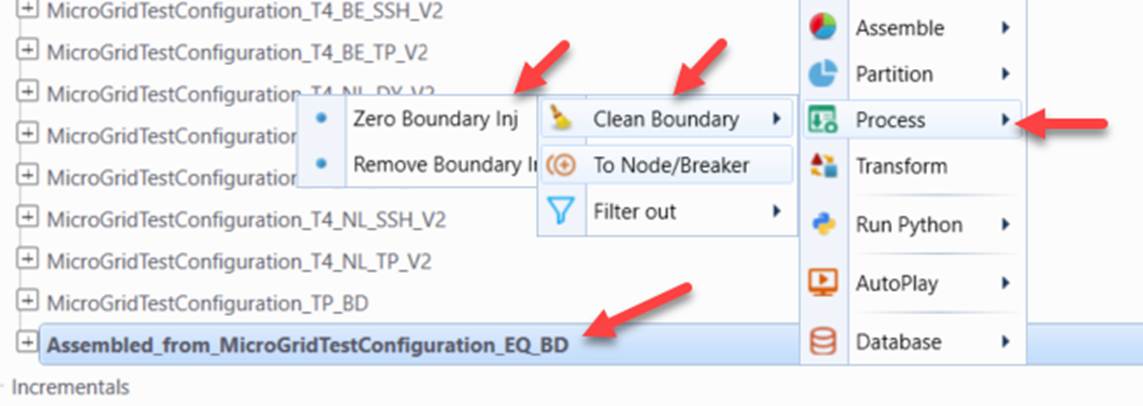
- Invoke a model cleaning command via a context menu associated with the assembled model (i.e. Process→Clean Boundary→Remove Boundary Inj (Zero Boundary Inj.)_ . Note the Clean Boundary context menu is only available for an assembled model that contains Equipment, Topology, and State Variables data group.
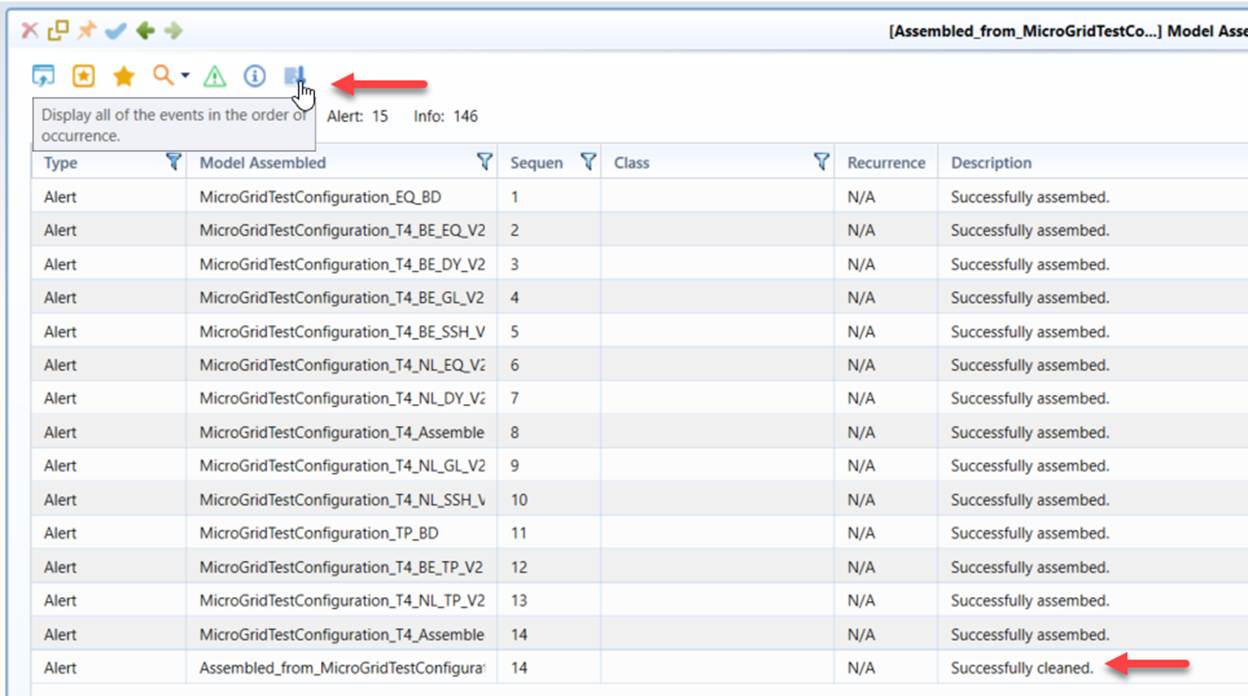
- Once the model cleaning is completed, an event will be logged in the Model Assembling Summary Report. Note: model cleaning is an extension of model assembling. The detailed logged events can be displayed from the model assembling summary report, as illustrated below

- Run the validation for the cleaned model.
Note: The Tool relies on a built-in mechanism to determine which boundary injections shall be set to 0 or removed depending on users’ selection. It only performs the selected house cleaning tasks for the boundary nodes that have been ‘stitched’ on both sides. If only one regional model is connected to the boundary node, the tool will retain the connected shunt MW/MVAr injection.
Model validation also provides support for users to clean the model by detecting the garbage left during the model maintenance. This is achieved through network topology analysis and detection of object islands.