Assembling Data Groups
Driven by common business practices in electric power industry, CIM is divided into different data groups, each specified by a profile. A Profile is schema that defines the structure and semantics of a model that may be exchanged.. Each profile specifies a subset of the CIM classes and attributes specific to a business context or an application domain. For example, IEC 61970-452 describes CIM Static Transmission Network Model Profiles (also referred to as CPSM profile). The ENTSO-E profile describes a power system planning model exchange specifications. In general, a CIM profile serves as a contract or agreement among parties that exchange the information under the CIM umbrella.
The Tool supports the following data groups and their governing standards:
| Data Group/Profile | Governing Standards | Description |
| Equipment | Static Transmission Network Model Exchange (61970-452, 61970-600) | Specifying a static transmission power system model necessary to execute state estimation or power flow applications. This Equipment data group could describe an EMS operational (node-breaker) model or a planning (bus-branch) model. In the former case, the profile is also referred to as CPSM profile. |
| Steady State Hypotheses | Steady State Hypotheses (61970-456) | Initial topology and state variables typically used as input of power flow studies. |
| Topology | Solved State Exchange (61970-456) | Result of network topology analysis. |
| State Variables | Solved State Exchange (61970-456) | Describing a steady-state solution of a power system case, such as those produced by power flow or state estimation applications. |
| Dynamic | Dynamics (61970-457) | Describing various models used for dynamic power system studies |
| Diagram | Schematic Layout Exchange (61970-453) | Specifying semantic model used to exchange schematic diagram (one-line diagram) layout information |
| Geographical | 61968 | Specifying semantic model used to exchange geographical information of power system resources |
It is important to note that these data groups are not independent of each other. Typically, a data group depends on the other. For example, a Topology data group depends on an Equipment data group and a State Variables data group depends on a Topology data group. In model files conforming to CIM 15 and later versions, these model dependencies are described at the header section of a model file. To build a study case properly, different data groups must be assembled in right sequence.
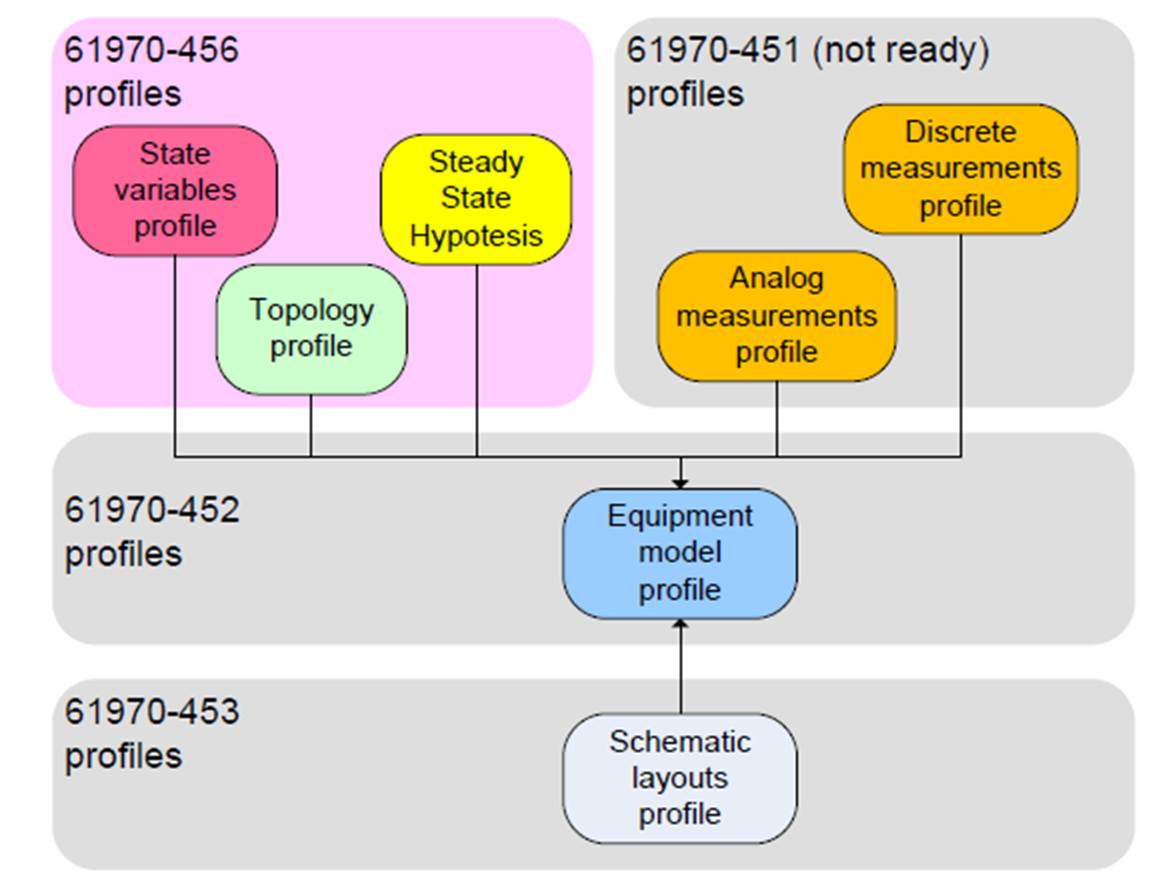
The Tool provides various options for supporting assembling and partition of data groups:
- Consistency Checking: enabling users to perform a consistency checking prior to model assembling.
- Unrestricted Model Assembling: allowing any two selected models to be assembled. This option yields the full control to users.
- Automatic Model Assembling: automatically detecting the model dependencies based on model Header specification and performing model assembling/assembling sequentially based on the detected model dependencies. This feature provides a one-stop solution for assembling various data groups submitted by different model authorities and then assembling them into a region-wide study case.
- Partition of an Assembled Model: Splitting a assembled model into various data groups based on the governing profiles.
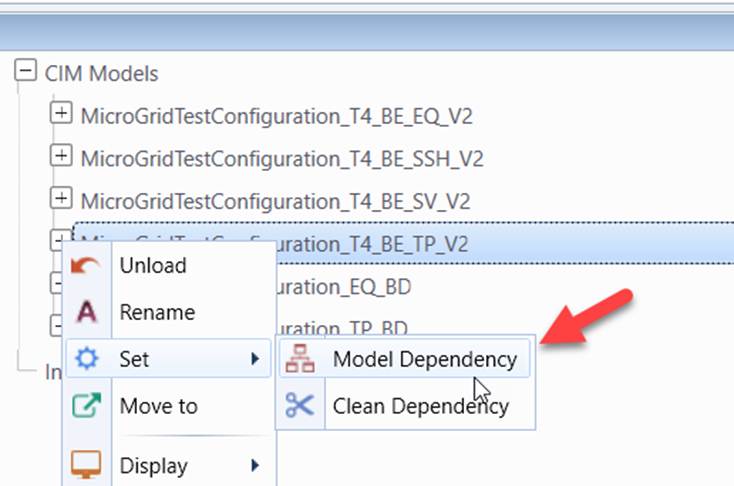
Model dependency described in model header is critical for Automatic Model Assembling. If model dependency is missing, users can manually set model dependency, as illustrated below. If model dependency is incorrect, users shall first clean model dependency by removing the model dependencies, and then reset the model dependency.
Note
Model dependency is only available for CIM 15 and later.