Conversion of Bus/Branch to Pseudo Node/Breaker
Region-wise model assembling involves assembling multiple model authority sets (MAS) into a single interconnected regional model. In reality, each MAS is built and maintained by a different model authority (MA). Different modeling practices may be used to build and maintain MAS. For example some of MAS are node/breaker models, while others are bus/branch models. Both are accepted modeling practices according to CGMES. Consequently, the resulting assembled pan-European is a mixed bus/branch and node/breaker model. Such an assembled model may be difficult to consume. This is particularly true if the model consumption applications/systems deal with only node/breaker model.
To facilitate model consumption of assembled model, the Tool provides a data engineering function to create pseudo node/breaker from bus/branch. This allows users to convert a bus/branch model to a node/breaker model, or a mixed bus/branch and node/breaker to an assembled model supporting both node/breaker and bus/branch. This function can be invoked from the context menu Process→To Node/Breaker. Note: this function is only available for the assemble model which contains at least EQ and TP.
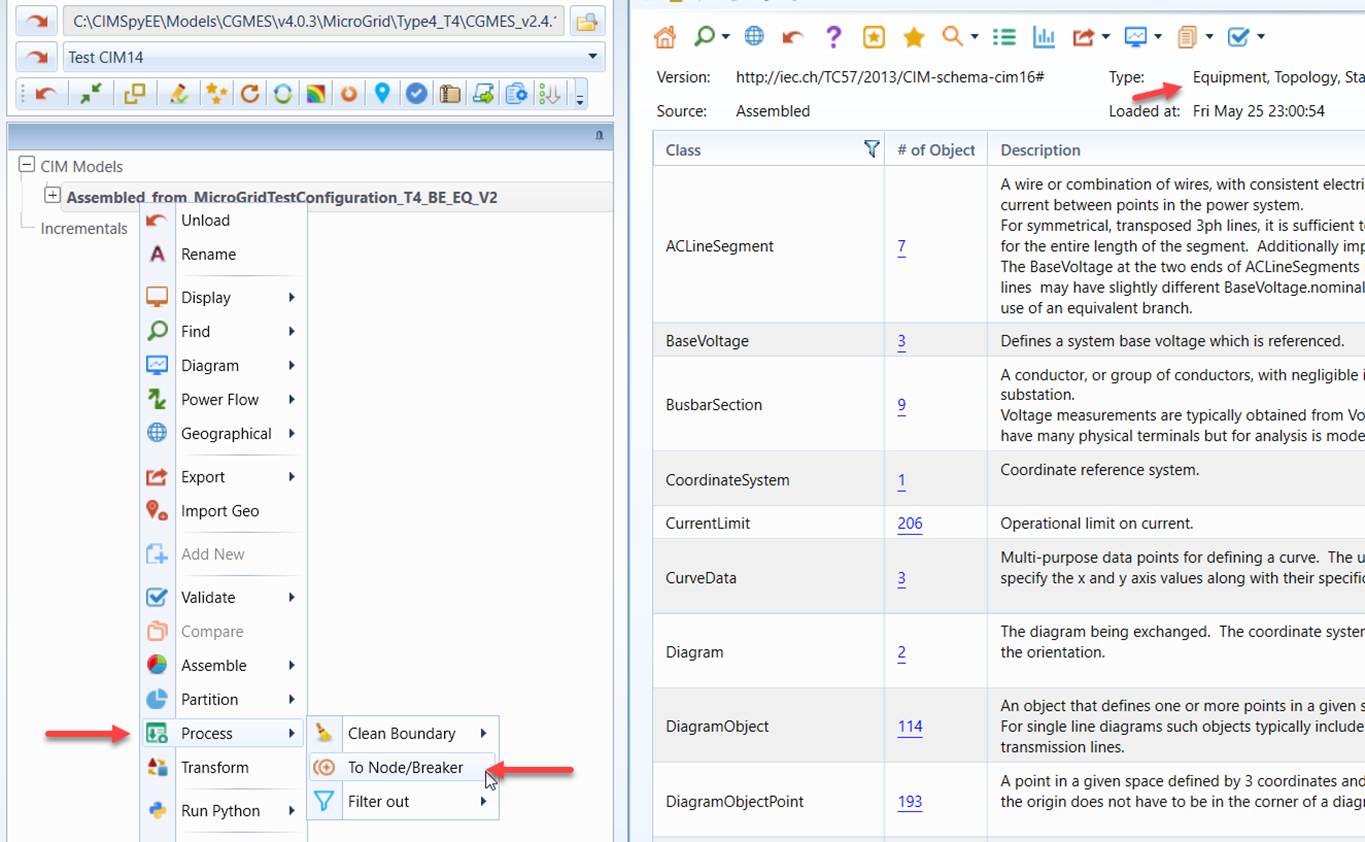
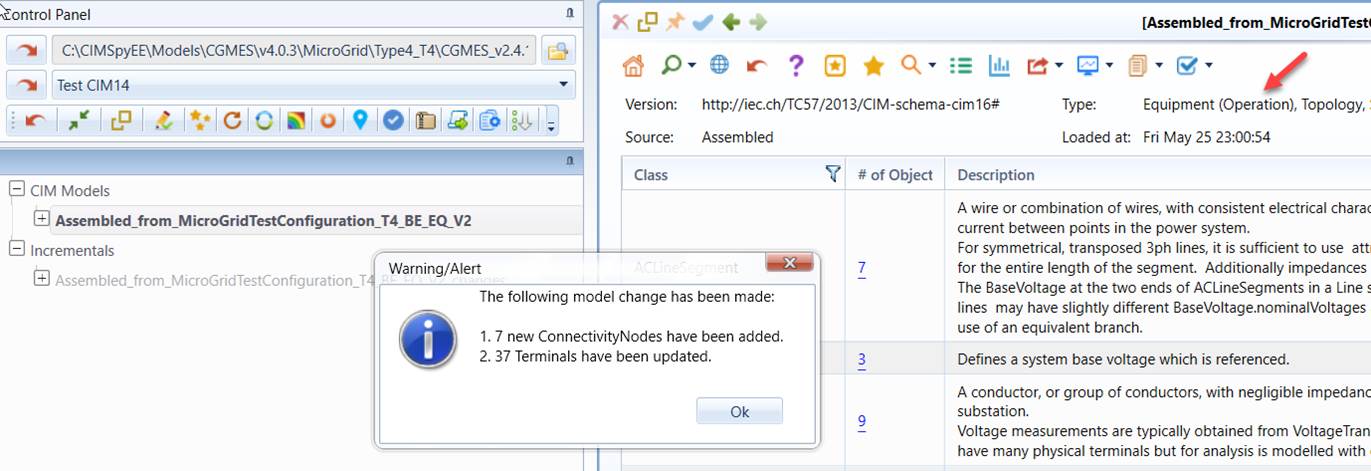
Once invoked, the Tool will create a pseudo ConnectivityNode for each TopologicalNode that doesn’t have a corresponding ConnectivityNode, and then update the corresponding Terminals. The resulting is an assembled model that fully supports both bus/branch and node/breaker.
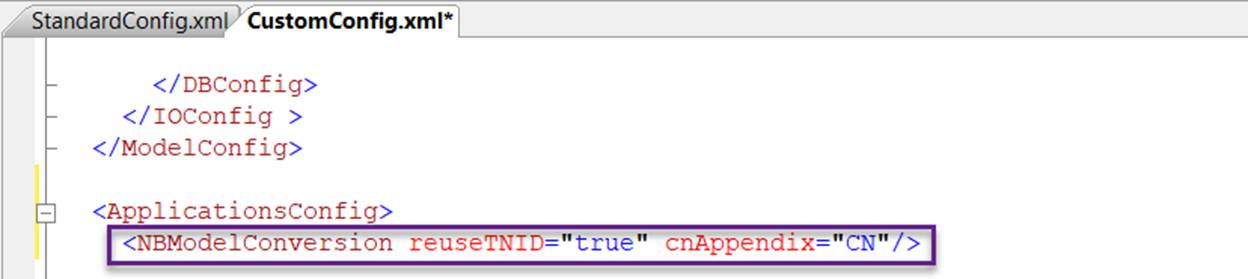
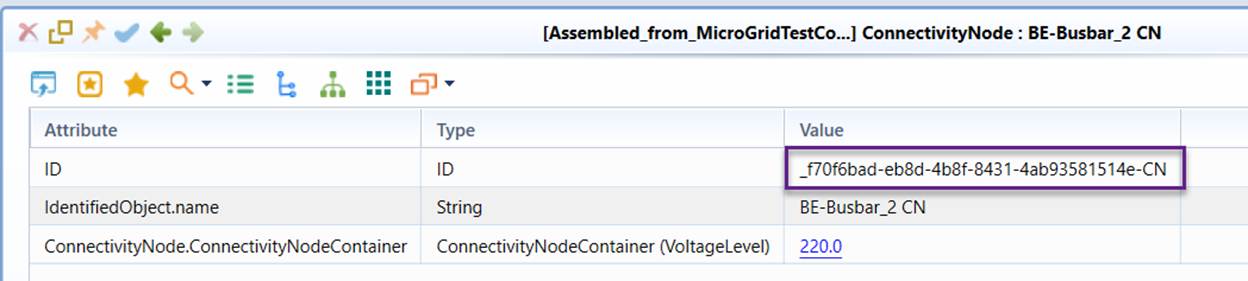
By default, when creating pseudo ConnectivityNodes, the Tool auto-generates a UUID-based rdf:ID for each new ConnectivityNode. This behavior can be changed by adding a configuration segment in CustomConfig.xml under folder \CIMSpy\config, as illustrated below. Once attribute reuseTNID is set to ‘true’, the Tool will reuse rdf:ID of the corresponding TopologicalNode by appending a string specified by attribute cnAppendix, as illustrated below.
Users shall determine whether this customization shall be applied. The problem with this customization is the rdf:IDs generated are no longer UUID-compliant. However, there are two benefits with this customization:
- The rdf:IDs generated for the pseudo ConnectivityNodes are consistent. The same rdf:IDs are always generated in sync with those of the corresponding TopologicalNodes.
- The rdf:IDs generated for the pseudo ConnectivityNodes are traceable. Users can identify what ConnectivityNodes are pseudo ConnectivityNodes and which TopologicalNode each pseudo ConnectivityNode corresponds to.