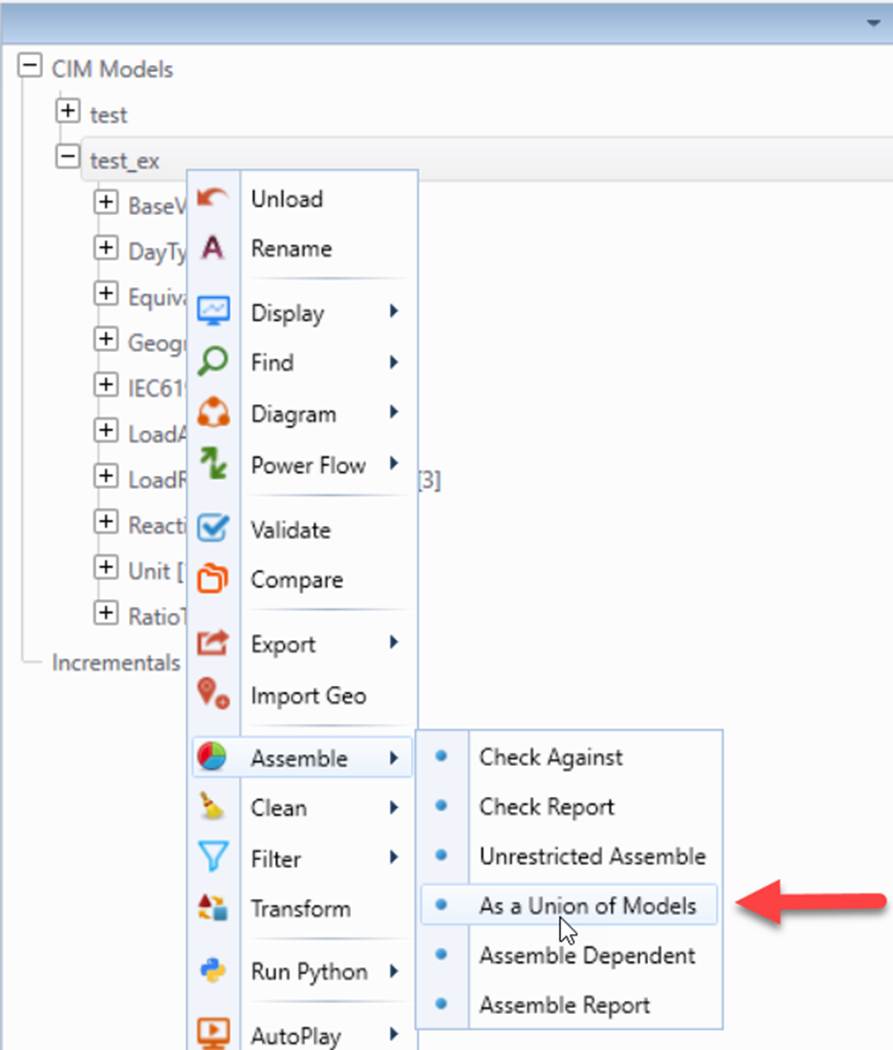
Assembling As a Union
Assembling as a Union is a variation of Unrestricted Model Assembling. It is designed to support use cases where two models originated from the same source need to be combined. This assembling process is similar to Unrestricted Model Assembling, except that it combines two models as a union. The overlapped part of the two full models will be retained, while the additional properties of the 2nd model will be added to the 1st model, referred to base model.
More specifically, in the Unrestricted Model Assembling, if objects from the 2nd model are identified by the same rdf:ID (not identified by rdf:about) as in the base model, they will be ignored and error messages will be issued. In other words, duplications ae not allowed. However, when assembling as a union, the additional attributes from the 2nd model will be merged into the base model. The resulting is a union of two models, containing the full set of base models, as well as the additional objects/properties from the 2nd model.
It is important to note that this process is not associative. In other words, A→B is not equivalent to B→A. This is because if properties of same object from two models are not the same, only the properties of the base model will be retained. Base model is the master. The overlapped part from the 2nd model will be ignored. If users would like to retain the overlapped part from the 2nd model, then the assembling direction shall be reversed.
Executing Assembling as a Union is similar to execution of Unrestricted Model Assembling, as illustrated below.