About PowSyBl
Power System Blocks (PowSyBl, www.powsybl.org) is an open source framework dedicated to electrical grid modelling and simulation.
- PowSyBl was initiated by Réseau de Transport d'Électricité (RTE, France's transmission system operator), and contributed to LF Energy in 2019.
- PowSyBl is written in Java and licensed under the Mozilla Public License 2.0.
- PowSyBl provides importers and exporters for several common pan-European exchange formats, including CGMES 2.4.15 (based on CIM 16).
- PowSyBl as a library provides several APIs for power system simulations and analyses, including:
- Power flow computations
- Security analyses
- Remedial action simulations
- Short circuits computations
- Sensitivity computations
- Time domain simulations
- PowSyBl was designed to support high-performance computing (HPC).
Evaluation of PowSyBl
Comprehensive investigations have been conducted to evaluate PowSybl from various perspectives. The following strength has been identified:
- Solvability – PowSybl was tested with 29 test models, including 18 reality-based models. 17 of them are solved with quality results, matching those published by other power flow tools. One of them is also solved after manually fixing a known issue. See the table below for testing results.
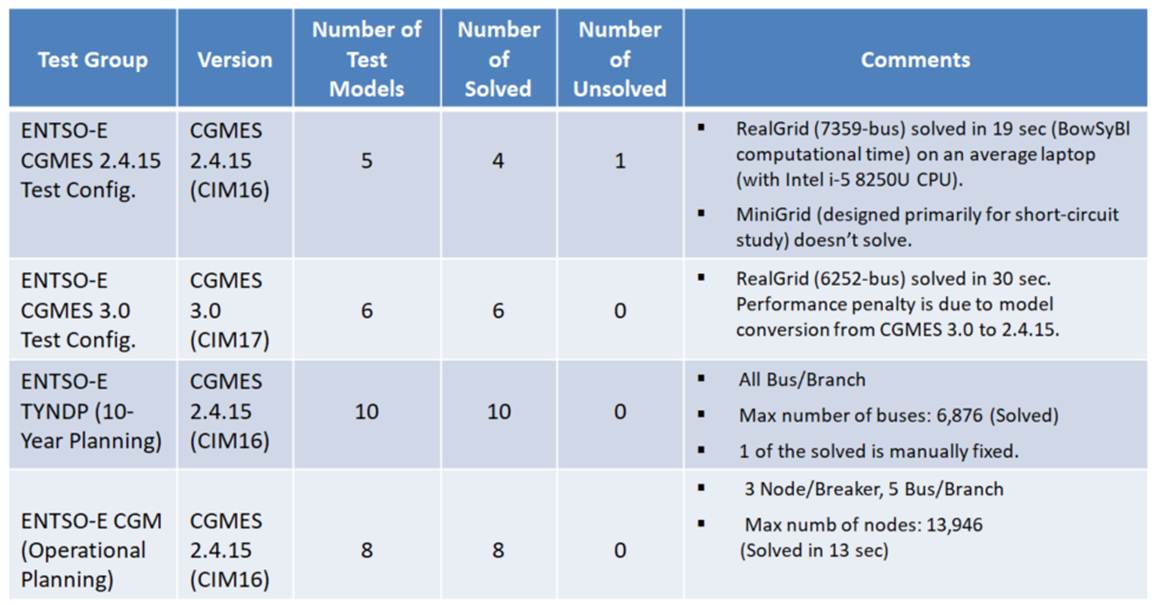
- Easy to Integrate – It takes little effort to integrate PowSyBl with the Tool. The real integration effort is one-man-week. The rest was to develop workarounds to support CGMES 3.0 and bypass some of the issues that have been fixed in the new release. This is mainly due to solid support of CGMES standards by PowSyBl.
- Configurability & Extensibility – PowSyBl was elegantly architected and designed with “building block” or modularity in mind. This is essential for users who want to extend and plug-in their customizations.
The following areas of improvement are also proposed:
- Robustness – The following are proposed to further enhance robustness of PowSyBl:
- Some of the identified issues should be addressed. While workaround is available, these issues could be road blockers for some users.
- While it is important to conform to CGMES standards (primarily used in Europe), PowSyBl should be enhanced to support CIM standards in general. As an example, PowSyBl should be able solve a CIM-16 based model that contains EQ and SSH information, but without any CGMES meta-data (i.e. the header).
- Usability & Performance – The following features are proposed to improve usability and performance:
- Supporting Assembled Model: Users should be able to import an assembled model (EQ + SSH + TP) and run power flow.
- Supporting Batch Process: Users should be able to import EQ + n x SSH to generate n x SV.
- Supporting Model Persistence: Users should be able import EQ/EQ_BD/TP_BD once and use them repeatedly for running power flow with various SSHs.
- Integrability – REST Web APIs can be developed to facilitate integration. This allows any applications to be able to easily consume PowSyBl services via Web/cloud.
Integration of PowSyBl with the Tool
To integrate with PowSyBl, an adapter is built to exchange data between the Tool and PowSybl, as illustrated below.
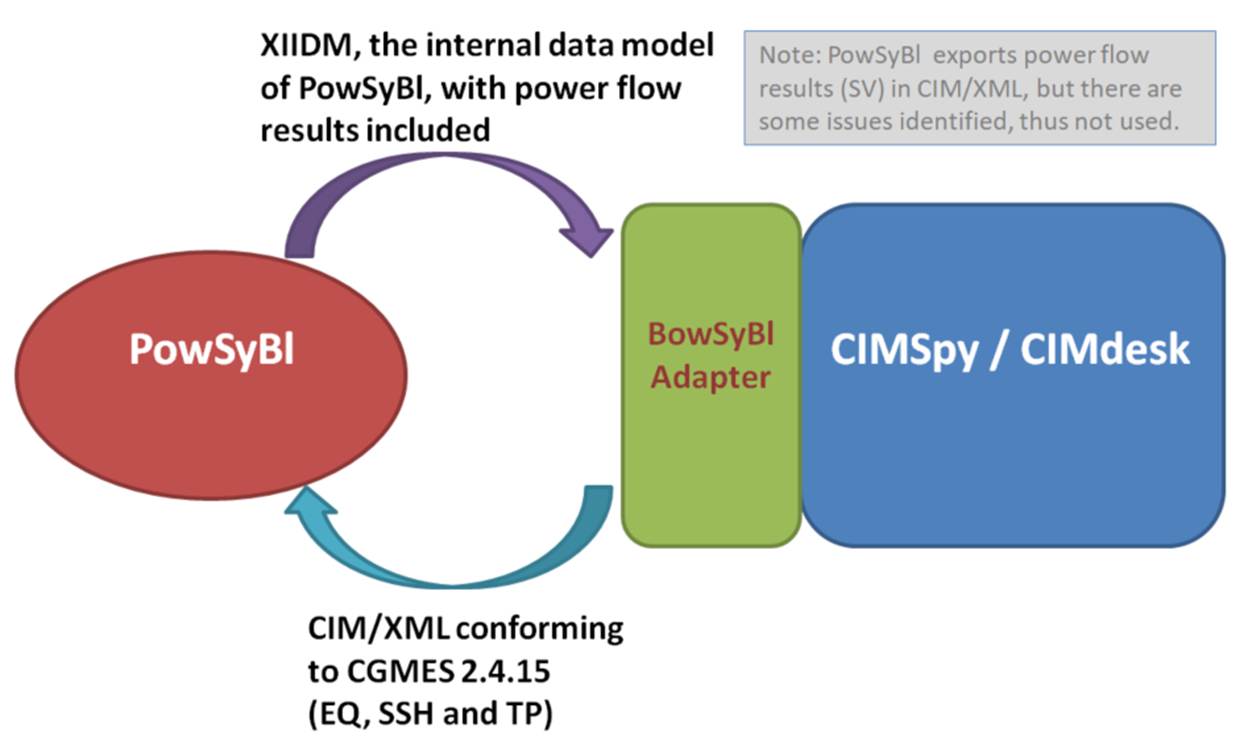
The main functionality of the adapter is summarized as following:
- Validate the input data sets to ensure the modeling information required to run power flow is available.
- Run topology analysis to create Topology (TP) model part as needed.
- Partition assembled model into model parts required by PowSyBl.
- Convert CGMES 3.0 to CGMES 2.4.15 supported by PowSyBl.
- Add/fix the meta-data (i.e. FullModel) if missing or invalid.
- Parse the output xiidm file to populate SV model part.
- Replace the SV model part/contents as needed.