Assembling Regional Models
The Tool supports regional model assembling based on the CIM concept of Model Authority Sets (MAS). The concept allows an interconnection model to be divided into disjoint sets of objects, and that in turn allows different parties to take responsibility for different parts of the complete model. Under this methodology, each object instance is assigned to one and only one Model Authority Set implicitly or explicitly. The assigned MAS manages the lifecycle of the instance.
There are two types of Model Authority Sets:
- Boundary Sets contain boundary objects that mark the boundary between region models. Boundary sets are managed by one authority but defined by mutual agreement.
- Regional Sets contain regional model objects. Objects in regional sets have internal associations and may have associations to boundary objects, but regional objects may never have associations to objects in other regional sets. This allows regional modeling to be carried out independently of other regions.
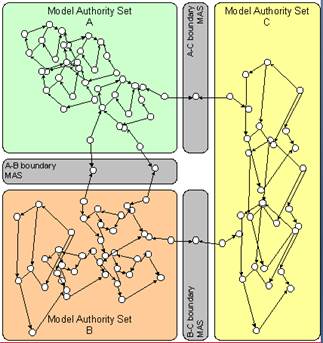
*Source of the picture: from CIM User Group Meeting, Fall 2009, presented by Jay Britton
Boundary Sets, containing the shared modeling entities, are used to decouple the Regional Sets. Therefore, Regional Sets only depend on Boundary Sets, but never rely on other Regional Sets. Boundary Sets are defined based on the mutual agreement among parties. In Pan-European transmission grid, for example, the Boundary Sets are simply a collection of nodes in the middle of tie-lines (referred to as XNode). These XNodes are maintained by the grid coordination organization, i.e. ENTSO-E.
Based on the MAS concept, assembling of a regional model simply becomes a matter of stitching the Regional Sets with the Boundary Sets. The Tool provides the following options in support of MAS-based regional model assembling
- Consistency Checking: enabling users to perform a consistency checking prior to model assembling.
- Unrestricted Model Assembling: allowing any two selected models to be assembled. This option yields the full control to users.
- Automatic Model Assembling: automatically detecting the model dependencies based on model Header specification and performing model assembling sequentially based on the detected model dependencies. This feature provides a one-stop solution for assembling various data groups submitted by different model authorities and then assembling them into a region-wide study case.